



What is an Holistic approach to Wellbeing?
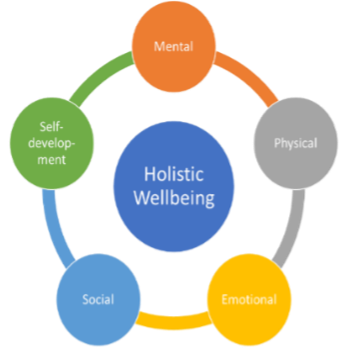 In our view, it is an integrative way of embracing wellbeing and resilience, reflecting and requiring a ‘whole system approach’, whether that’s the organisation and all of its component parts, or whether that’s the individual and all aspects of a person’s wellbeing.
In the case of individual wellbeing, the 5 components outlined here represent the different aspects of our overall health and wellbeing:
- Physical (movement/energy/nutrition)
- Mental (thoughts/beliefs/worldview)
- Emotional (processing/relationship/state)
- Social (connection/relationships with others/belonging)
- and Self- development (purpose/meaning/values/identity)
In an organisational setting, those components may look a little different; however, I believe they’d work along similar principles, as outlined below.
Physical:
How the environment, facilities and culture support people to move, exercise, eat well, take breaks, build rest, balance and get outside into their day. Physical wellbeing involves taking care of your body through regular movement, proper nutrition, and sufficient rest. In an organisational context, this means creating an environment that encourages healthy habits, such as offering ergonomic workstations, promoting active breaks, and providing access to nutritious food options.
Mental:
The beliefs, stories, messaging, strategies and narrative around wellbeing and how they enable people to have space to be creative, contribute ideas, process, learn, develop and to thrive and grow. It’s about how we perceive and interpret the world around us. For organisations, fostering mental wellbeing means promoting a culture of continuous learning, creativity, and open communication, where people feel empowered to express their ideas and grow.
Emotional:
The feelings, emotions, engagement and experience of working in the organisation. Emotional wellbeing involves understanding and managing our emotions in a healthy way. It’s about creating an environment where individuals feel emotionally safe, supported, and valued. In a workplace, this might mean encouraging open dialogue, implementing peer support networks or offering regular check-ins with managers which can help employees manage stress and build stronger emotional resilience.
Social:
The connections, networks, relationships, groups and mechanisms that enable people to feel a sense of belonging, psycho-social safety and identity within the organisation. Social wellbeing centers around building and maintaining strong, supportive relationships with others. This includes feeling connected to your colleagues and having a sense of belonging within the organisation. Social wellbeing can be nurtured through team-building activities, collaborative work environments, and opportunities for social interaction such as regular team lunches or after-work gatherings which can strengthen bonds among people, fostering a more cohesive and supportive work culture.
Self Development:
The ways in which the organisation enables individuals to learn, develop, grow and enhance the connection and sense of meaning to the organisation’s purpose, mission, values and vision. Organisations can support this by providing opportunities for career advancement, personal development workshops, and mentorship programs. Offering leadership training or encouraging people to pursue personal projects can help them feel more aligned with the company’s mission and more fulfilled in their roles.
Why does it matter?
By taking an holistic approach to wellbeing, we enable a whole-system, whole-person view in our wellbeing offerings as organisations, no matter if we are a 1 person or 10,000 people business. Which means that we are proactive and intentional in aligning our processes, systems, leadership, people management, policies, etc to the culture we want people to experience.
Wellbeing, therefore, becomes a strategic enabler for effective, high-performing organisations—a key input to achieve a greater outcome.
Another key factor is the rise in chronic conditions. Why is this relevant?
Well, chronic conditions, by their very nature, can cause significant stress, anxiety and depression, as well as other health and wellbeing implications for individuals and those around them. And organisationally this can cause many issues for teams due to absences, workload imbalances, shortages, engagement, productivity etc.
Chronic conditions also require an holistic approach to wellbeing, because it isn’t possible to resolve them by focusing on one area, such as simply physical treatment for example. Usually they require holistic solutions, lifestyle changes and a combination of factors in order to either recover from them or to manage them on an ongoing basis.
According to the World Health Organisation (WHO), ‘non-communicable diseases are claiming around three-quarters of all lives lost each year. If current trends were to continue, by around 2050, chronic diseases such as cardiovascular diseases, cancer, diabetes and respiratory illnesses will account for 86% of the 90 million deaths each year, a 90% increase in absolute numbers since 2019’ (UN news, 19 May 2023).
This reinforces the need for a partnership approach to holistic wellbeing, so that organisations and individuals can each play their part in helping people to be well, build resilience, reduce unhelpful stress and to have an environment that enables them to enhance their overall wellbeing.
The joint investment is necessary, which, if done well, can result in healthier, more productive, engaged and more resilient teams and organisations who perform better, innovate, are successful and who sustainably deliver and grow. This,in turn, provides a virtuous circle of security, revenue, opportunities, development, growth, purpose, meaning and accomplishment for people, their families, communities and on a bigger scale, nations.
Or if we don’t invest as needed into people’s wellbeing and resilience, it will likely result in a lack of productivity, performance, growth and revenue at an organisational level. This impacts families, communities and societies. Conversely, this results in a vicious circle: poor population health, increased pressure on public health and care services, less economic stability, increased crime, deprivation, etc.
What benefits can having an holistic approach enable?
For organisations, an holistic, strengths-based approach to wellbeing inherently builds a culture of compassion and care for one another; a willingness to take accountability and contribute positively, where ideas, input, skills and engagement are welcome and encouraged.
In our experience, where wellbeing is prioritised, leaders and managers are supported and equipped to build resilient teams, networks and mechanisms exist for people to collaborate and connect, and there is a tangible ‘feel’ that people are valued. Challenges and conflict are managed well, communications are transparent, opportunities to learn, develop and listen are actively sought out, and there is a visible inclusiveness in the way that the organisation operates, at all levels.
Additional Benefit – Enhanced Creativity and Innovation:
When employees feel mentally, emotionally, and socially supported, they are more likely to engage in creative problem-solving and innovation. This is because they are not bogged down by stress or burnout, allowing their minds to explore new ideas freely.
For individuals, holistic wellbeing:-
- Recognises individuals as more than just the sum of their parts, helps to see the interconnectedness of our lives.
- Provides a better ‘work-life integration’, which is a desire for the vast majority of people to experience more of what fulfils them and makes them happy.
- Encourages greater self-awareness, so that people are more open, intentional and considerate of their behaviours and impact on others.
- Ensures that we recognise and treat each individual as unique and don’t assume the same thing will work for everyone.
- Ensures that we have a range of practices that support each aspect of our wellbeing needs. Things that will be helpful for our mind may be different from what we need for our physical body and our emotional processing, social connections, sense of purpose, meaning, and values.
- Enables an integrative approach, which means that many things will benefit us in multiple ways, if we can find those and integrate them into our lives, we maximise the benefit we can get from them.
Ok, so if we see the benefits, how can we achieve it?
For organisations, there are some key actionable strategies that can build a holistic wellbeing approach:-
- Ensure buy-in from senior stakeholders, so that leaders’ commitment, role modelling and behaviours are aligned to enabling a wellbeing culture.
- Empower managers and leaders to take a proactive approach – equipping them with the tools, insights, resources and ways of working to be able to help build resilient teams.
- Ensure that the processes, systems, development, management and infrastructure enables people to have a positive approach to their wellbeing and doesn’t constrain or prevent this.
- Ensure the organisational culture and ways of working give people the trust and autonomy to meet their own work-life integration and consider others’ needs too.
- Ask what people want and listen, use mechanisms for teams to bring their own ideas and self-manage wherever possible.
- Encourage individuals and teams to take ownership of their spaces and bring creativity and fun wherever they can in real and virtual environments.
- Provide a range of wellbeing-related support and options so that people can select what is most helpful based on their circumstances and recognise that this will change depending on those circumstances.
- Promote culture change to support a holistic approach (engaging involving staff in decision-making and groups, etc to educate/engage on what it means in practice).
- Choose the right measures to assess the health and effectiveness of the organisational wellbeing culture and use relevant data to measure success.
- Support by providing development and educational opportunities that are accessible, relevant and engaging, so that people feel empowered to learn how to improve their wellbeing.
For individuals:-
- Take a bit of time and space to consider where your holistic wellbeing is currently?
- Perhaps reflect on what you already do that helps physically, mentally, emotionally, socially and in your self-development?
- Are there any gaps or areas you’d benefit from strengthening?
If you’d like to learn more about implementing a holistic wellbeing strategy in your organisation, please contact us for a free consultation and discover how we can help you build a resilient and thriving workplace. Call: 0161 969 2512 or email: info@Co-Creation.Group.